Why Screenshots Fail in Court: Verifying Digital Evidence Metadata
Introduction
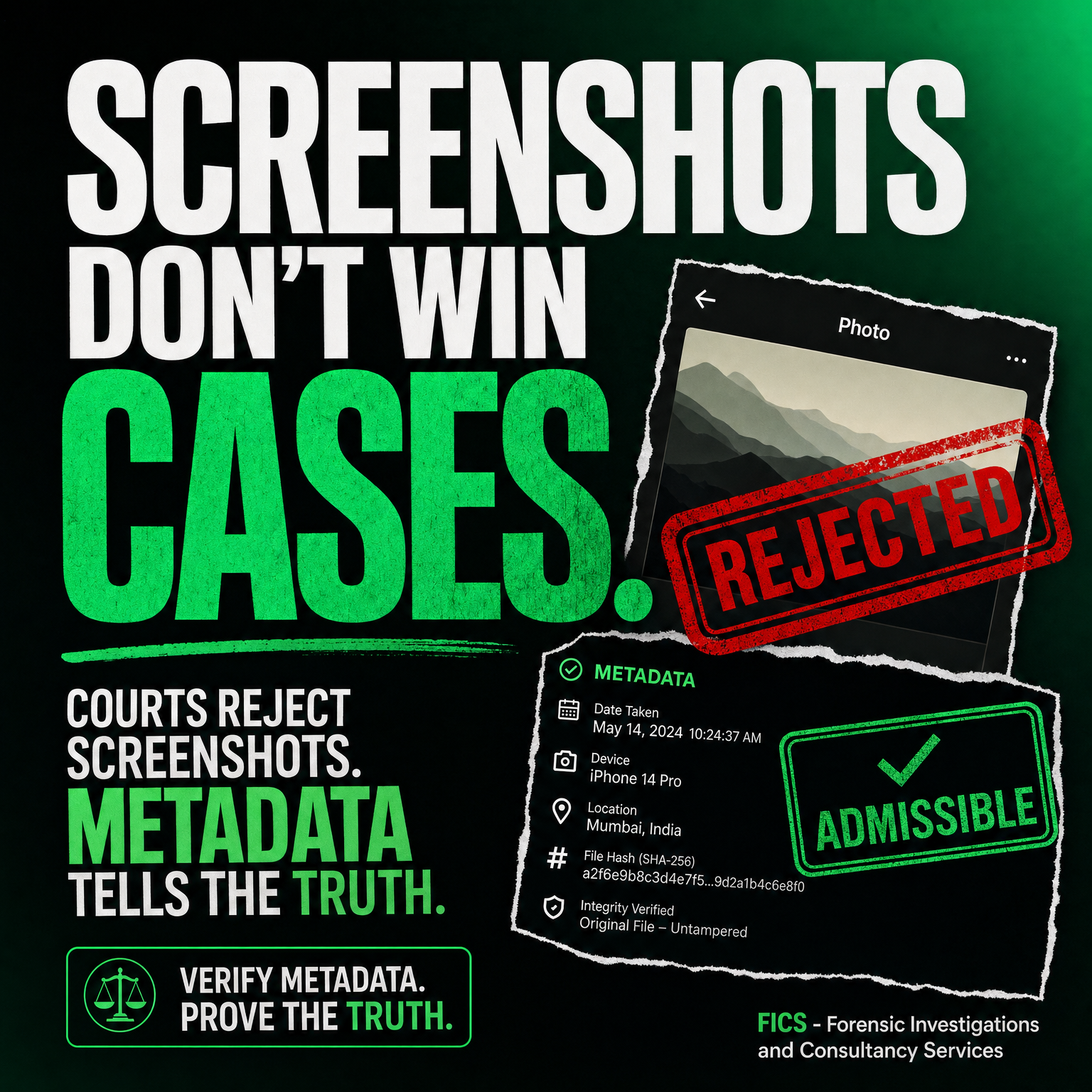
In modern civil and criminal litigation, legal teams frequently attempt to submit smartphone screen captures, social media grabs, and text thread images as primary exhibits. Relying on raw screen captures is one of the most high-risk procedural mistakes counsel can make. Surface-level screenshots lack systemic metadata verification, rendering them highly vulnerable to exclusion under strict judicial scrutiny.
Recent industry analyses, including reports from the International Investigative Group, highlight a growing wave of court rejections where litigants rely solely on unverified visual representations. Judges consistently hold that visual pixels alone cannot establish authenticity, authorship, or historical context. A screenshot simply proves what appeared on a display at a single moment, not who generated the content, when the underlying event occurred, or whether the text was modified beforehand.
At FICS (Forensic Investigations and Consultancy Services), our forensic experts routinely observe evidence being suppressed because legal counsel mistook a visual image for genuine forensic proof. To survive motion practice and evidentiary challenges, electronic evidence must be backed by verifiable digital evidence metadata, robust chain-of-custody protocols, and certified forensic extraction techniques.
Why Screenshots Fail in Court: The Admissibility Gap
A standard screen capture creates a brand-new image file (such as a PNG or JPEG) at the exact second the capture button is pressed. It records visual pixels rather than the underlying database records, transmission headers, sender GUIDs, or server time logs. Anyone with basic image-editing software or browser inspection tools can fabricate or alter text, dates, and account handles in seconds without altering the technical structure of the resulting screenshot.
Under evidentiary rules such as Federal Rule of Evidence 901, evidence requires authentication sufficient to support a finding that the item is what its proponent claims. When opposing counsel challenges an unverified screenshot, the file cannot defend its own integrity. As detailed in the American Bar Association guidelines, courts mandate verifiable proof of authenticity that simple screen captures inherently fail to provide.
Common fatal flaws that trigger judicial rejections include:
- Absence of Native Metadata: Screenshots overwrite or omit original file creation dates, author identifiers, and device metadata, replacing them with data from the capture event itself.
- Unverifiable Authorship: An image demonstrates what was rendered on a screen, but cannot prove who actually sent a message or whether an account was spoofed.
- Contextual Omission: Isolated screen grabs conceal surrounding message histories, deleted replies, time-zone adjustments, and system status indicators.
- Ease of Manipulation: Modern web utilities allow users to edit live HTML text on-screen prior to taking a image capture, leaving zero visual footprints.
Counsel looking to prevent procedural errors should review our analysis on Digital Evidence Handling Gaps: Oxford Study Insights for Counsel.
Verifying Digital Evidence Metadata: What Courts Require
To meet evidentiary standards, digital artifacts must retain systemic metadata—the hidden, programmatic logs embedded across file systems, application databases, and operating systems. Metadata serves as a digital fingerprint, confirming exactly when data was created, modified, transmitted, and received across network boundaries.
During forensic examination, investigators inspect SQLite databases, system event logs, header structures, and server audit trails rather than visual interfaces alone. For corporate and institutional environments, maintaining central logging systems is equally vital—a core operational reality detailed in our guide on NY DFS $250K Fine: Audit Log Lessons for Financial Institutions.
Litigation discovery experts emphasize why screenshots fail as evidence when collected without cryptographic hash values or raw source payloads. Without MD5 or SHA-256 hash algorithms generated upon collection, attorneys cannot mathematically prove that an exhibit remained unaltered throughout discovery and trial preparation.
Forensic Phone Extraction and Provenance Best Practices
Rather than taking manual screen captures, litigators must employ forensically sound collection protocols. Full physical or targeted logical extractions collect raw database records, system logs, and unallocated device memory, ensuring complete metadata preservation.
Forensic practitioners and courts increasingly recognize that courts rely on phone extractions—not screenshots to establish legal authenticity in modern proceedings.
To protect digital evidence from challenge or exclusion, legal teams should mandate these six operational protocols:
- Halt Manual Captures: Prohibit staff and clients from relying on native phone or desktop screenshots for key case evidence.
- Execute Forensic Extractions: Utilize industry-certified forensic hardware and software (such as Cellebrite or Magnet AXIOM) to perform verified device extractions.
- Preserve Systemic Metadata: Ensure original header files, EXIF tags, server timestamps, and account IDs are captured with every artifact.
- Generate Cryptographic Hashes: Calculate SHA-256 hash digests immediately at acquisition to establish an unbroken verification baseline.
- Maintain Formal Chain of Custody: Document every instance of evidence handling, transfer, storage, and forensic processing.
- Engage Certified Forensic Experts: Retain expert witnesses capable of testifying to collection methodologies, database parsing, and metadata integrity.
Conclusion
The practice of submitting basic screen captures as central courtroom exhibits is no longer viable. Judges demand rigorous digital authentication, consistently penalizing parties that substitute surface images for authentic forensic artifacts. Attempting to present evidence without underlying digital evidence metadata exposes your case to evidence suppression, spoliation sanctions, and severe trial setbacks.
At FICS - Forensic Investigations and Consultancy Services, we provide litigators, corporate risk teams, and law enforcement agencies with court-defensible extractions, exhaustive metadata verification, and qualified expert testimony. Contact our forensic team today to evaluate and secure your digital evidence before entering court.