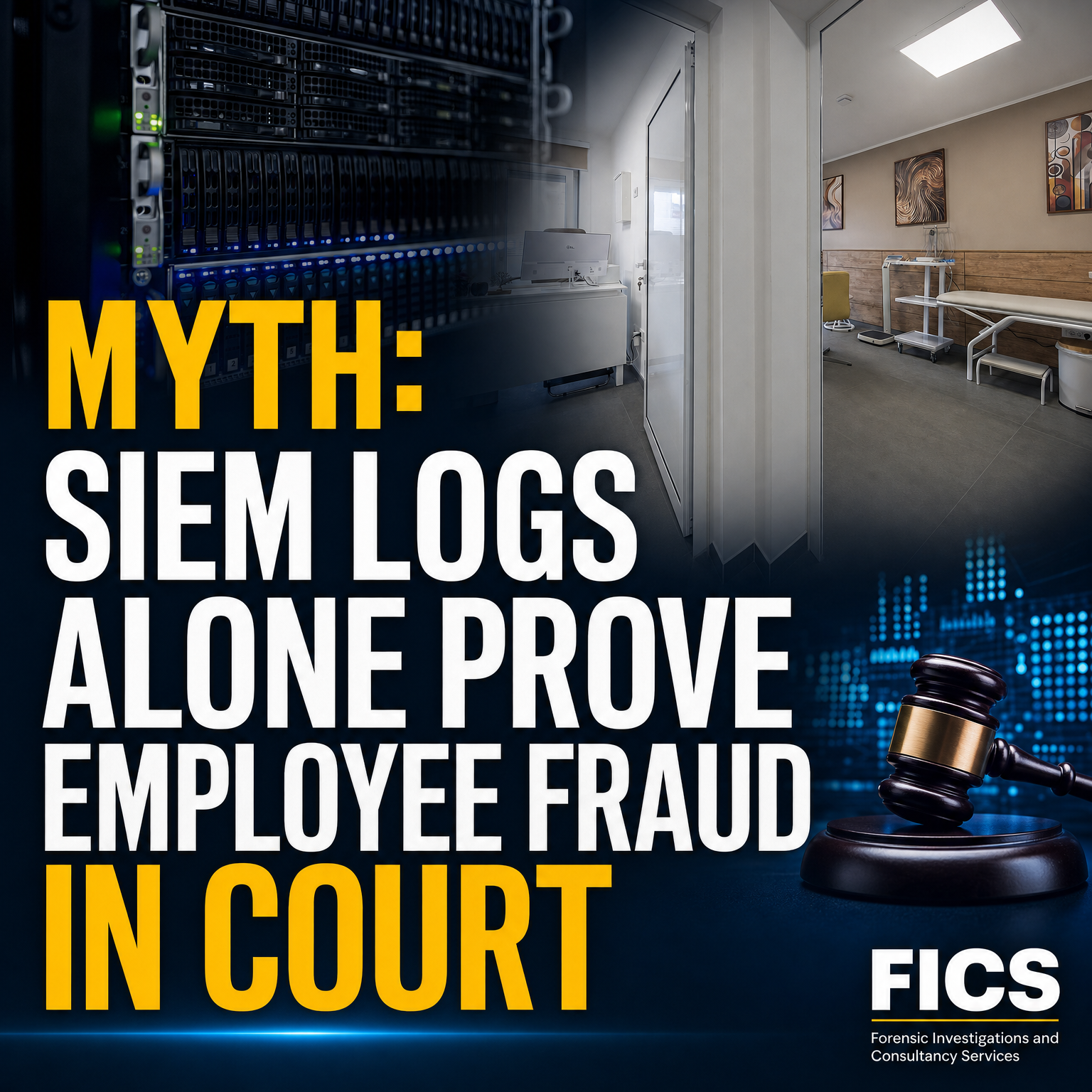
Myth: SIEM Logs Alone Prove Employee Fraud in Court
Introduction
When an enterprise suspects an internal breach or corporate theft, executive leadership frequently turns to their Security Information and Event Management (SIEM) dashboard. The internal audit team spots a line item showing that a specific employee account logged into a financial database at 2:00 AM and exported sensitive files. To leadership, the case appears closed. They assume that exporting this event log provides immediate, incontrovertible proof of insider fraud for civil litigation or criminal prosecution.
This assumption is a dangerous misunderstanding of digital evidence standards. Relying solely on SIEM telemetry to establish guilt in court fails under serious legal scrutiny.
The reality of modern corporate environments is stark: according to Gartner 2026 Security Operations data, 64% of credential misuse incidents leave no anomaly signatures in standard SIEM event streams. A user logging in with valid credentials appears completely benign to standard log collectors, regardless of whether that user is the legitimate employee, a compromised service account, or a malicious actor operating remotely. SIEM systems are built for real-time operational alerts, not courtroom evidence.
Why SIEM Logs Fall Short as Digital Forensics Admissibility Evidence
To successfully prosecute fraud or terminate an executive for cause, evidence must clear the high threshold of digital forensics admissibility. Standard SIEM logs regularly fail to meet this standard during judicial proceedings for three distinct reasons.
First, SIEM logs prove account activity, not human identity. A log entry records that an identity credential performed an action. It cannot prove non-repudiation—the legal certainty that a specific physical individual was sitting at the physical keyboard. If an employee claims, "My credentials were compromised by malware," or "I left my workstation unlocked when I stepped away," standard log streams cannot disprove their defense.
Second, SIEM telemetry frequently lacks forensic integrity. Centralized log collectors often ingest parsed, summarized event data over unencrypted syslog channels or API endpoints. Without cryptographic hashing at the exact time of generation, defense counsel can argue that log data was altered, truncated, or injected during aggregation. As detailed in our analysis of Forensic Logs vs API Tokens: Close Identity Audit Gaps, identity assertions without underlying cryptographic proof fail to establish absolute responsibility.
Third, system clock skew across distributed networks damages credibility. If your domain controller, database server, and SIEM collector maintain even slight timestamp discrepancies, establishing an accurate, sequential timeline of malicious intent becomes nearly impossible during cross-examination.
The Blind Spots of Log Data in Insider Threat Investigations
Executing a successful insider threat investigation requires understanding where network and event logging stop and where actual user activity occurs.
Consider a typical corporate fraud scenario: a rogue finance manager exfiltrates proprietary billing schemas. The SIEM records a standard HTTPS outbound connection and a successful login. What the SIEM misses completely are the critical context artifacts residing on the local host machine:
- Volatile Memory (RAM): Running processes, unencrypted payload fragments, and active session tokens that never hit the disk or log stream.
- Local File System Artifacts: Shellbags, LNK files, and jump lists that prove a specific user manually navigated directories and staged files for exfiltration.
- System Modifications: Registry edits or anti-forensic tools executed to scrub local event logs prior to forwarding.
When internal security teams rely strictly on log data, they overlook these volatile artifacts. As explored in our technical breakdown of Memory Imaging vs Network Logs: Catching Tampered Records, network and event streams only show the shadow of an action. Capturing volatile RAM and physical disk artifacts is the only way to expose concealed local manipulation.
Building Legal Proof of Corporate Fraud Beyond Standard Event Streams
Transforming corporate suspicion into court-admissible evidence requires moving beyond passive log aggregation. Organizations must deploy formal forensic methodology the moment an insider threat is identified.
To establish legally defensible proof of employee fraud, your investigative team must execute the following protocol:
- Secure Forensic Disk and RAM Images Immediately: Do not simply pull SIEM reports. Perform a bit-stream physical image of the suspect’s workstation and capture volatile RAM before rebooting or disconnecting the machine.
- Maintain a Rigorous Chain of Custody: Document every individual who touches the target device, complete with cryptographic SHA-256 hashes of disk images before and after analysis. Adhere to established best practices in digital evidence collection to ensure court acceptance.
- Analyze Local User Artifacts: Correlate SIEM timestamps with OS-level execution artifacts, such as Windows Prefetch, Shimcache, and USB connection registries, to prove physical human interaction.
- Avoid Sole Reliance on IT Backups: Standard disaster recovery backups are designed for operational uptime, not legal preservation. As explained in our guide on Why IT Backups Fail as Legal Evidence After a Breach | FICS, standard backups lack the bit-level integrity and context needed in court.
- Establish Intent and Premeditation: Fraud requires proving intent. Search for anti-forensic software installations, web searches regarding data destruction, or deliberate bypasses of security controls.
Conclusion
Relying solely on SIEM logs employee fraud evidence is a high-risk legal strategy that frequently leads to dismissed cases, unsuccessful prosecutions, and costly wrongful termination lawsuits. While a SIEM is an essential tool for enterprise security monitoring and initial incident alerting, it was never designed to act as an automated digital expert witness.
To secure actionable, court-admissible proof of insider misconduct, organizations must pair centralized logging telemetry with certified digital forensics, rigorous chain of custody procedures, and deep endpoint artifact analysis.
When corporate integrity and legal standing are on the line, ensure your evidence stands up in court. Partner with FICS (Forensic Investigations and Consultancy Services) to turn complex digital telemetry into indisputable legal proof.