How to Trace BEC Wire Transfers Within the FBI 72-Hour Window
Introduction
Business Email Compromise (BEC) remains one of the most financially devastating threats facing global organizations today. According to the Internet Crime Complaint Center (IC3), cumulative global exposure from reported BEC incidents exceeds $55 billion, with annual losses climbing past $2.9 billion in high-value transfers. Threat actors target corporate accounts payable departments, executive communications, and vendor payment channels to divert wire payments into adversary-controlled accounts.
When an unauthorized transaction occurs, financial institutions and victim organizations face a strict race against time. The primary mechanism for interdicting these funds is the Financial Fraud Kill Chain (FFKC), managed by federal law enforcement. To successfully recover stolen capital, security and risk leaders must understand how to trace BEC wire transfers and execute response protocols within a strict 72-hour timeframe.
At Forensic Investigations and Consultancy Services (FICS), our digital forensics teams routinely assist organizations in navigating critical cyber incidents. Understanding the technical mechanics of wire transfer recovery ensures your organization can respond decisively when fraud occurs.
Understanding the FBI 72-Hour Window to Trace BEC Wire Transfers
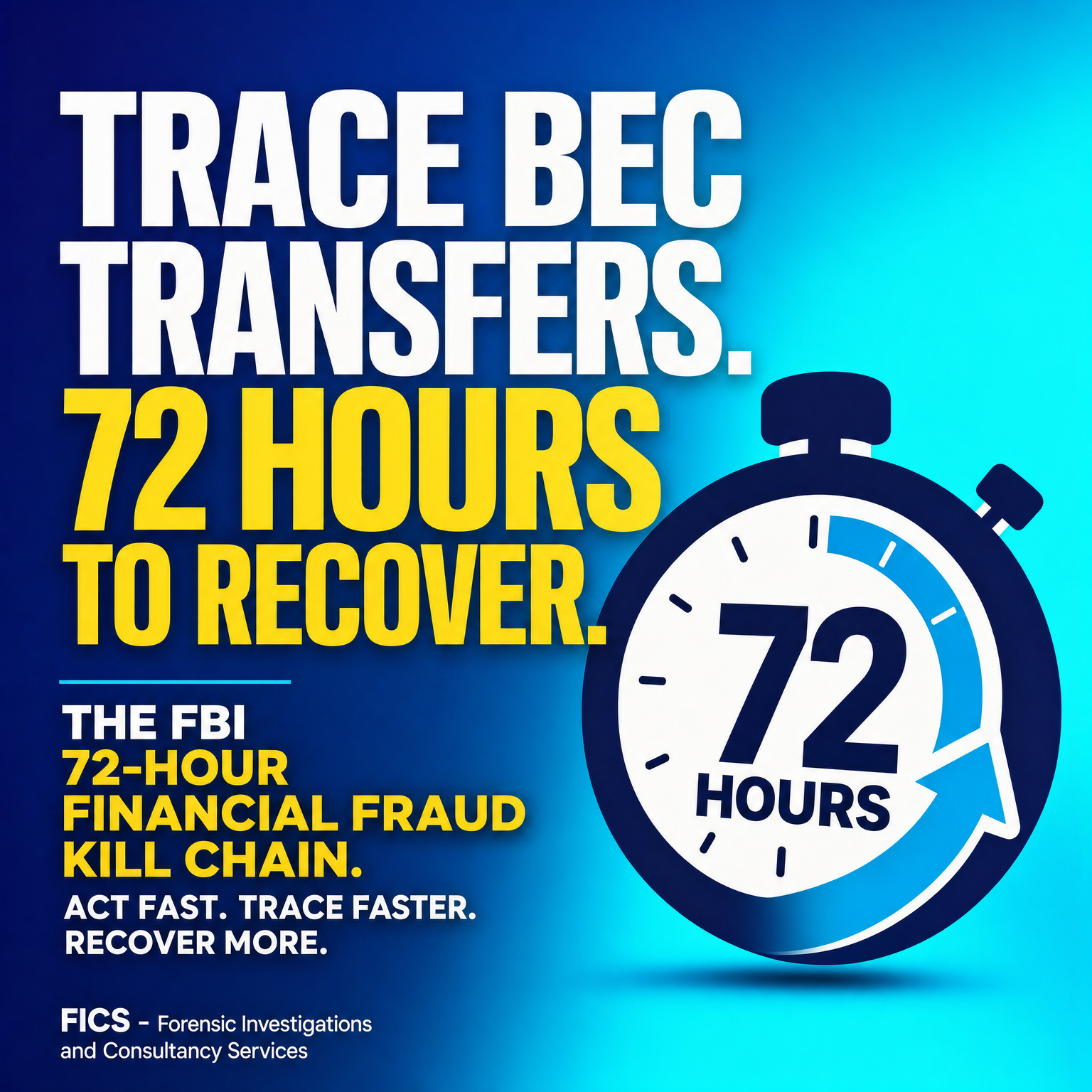
The 72-hour timeline is defined by the operational boundaries of federal interdiction mechanisms. Through coordination between law enforcement agencies and FinCEN's Rapid Response Program, authorities have successfully interdicted billions in cyber-enabled fraud losses. However, activating these recovery mechanisms requires meeting specific criteria before foreign financial institutions complete final settlement.
To trigger the FBI Financial Fraud Kill Chain, the wire transaction must fulfill four basic conditions: - The wire transfer must be equal to or greater than $50,000. - The transaction must be an international wire transfer or routed to a foreign beneficiary institution. - The transfer must have occurred within the last 72 hours. - A SWIFT message or administrative recall request must be issued by the sending bank.
When fraudulent funds hit a destination bank account, threat actors immediately initiate secondary wire transfers or crypto conversions to obfuscate the paper trail. Once stolen money leaves the initial correspondent bank account, successful recovery drops precipitously. Acting inside the 72-hour window allows law enforcement to place administrative holds on intermediary accounts before funds are withdrawn by money mule networks.
Technical Steps for Business Email Compromise Tracing
Effective Business Email Compromise tracing requires a two-pronged strategy: forensic analysis of the compromised email ecosystem and physical tracking of the banking transaction rails. Digital forensic investigators must collect precise transaction metadata to provide law enforcement and financial counterparties with verifiable proof of fraud.
First, secure the transaction documentation directly from your originating financial institution. This includes obtaining the full Fedwire confirmation report or international SWIFT MT103 record. The MT103 field detail provides critical routing routing data, including Field 50 (Ordering Customer), Field 57 (Account With Institution), Field 59 (Beneficiary Customer), and the Unique End-to-End Transaction Reference (UETR).
Second, investigate the initial intrusion vector to preserve evidence for legal proceedings. Attackers often deploy session hijacking tactics or compromised credentials to gain initial access. Reviewing administrative logs and authentication mechanisms is critical during this phase—especially when analyzing compromised identities, as seen in our technical analysis on INC Ransomware Steals MFA Seeds: Forensic Response Plan.
Finally, compile unedited RFC 822 email headers from the fraudulent wiring instructions. These headers expose the sending server IP address, originating mail transport agent (MTA), and reply-to manipulation. Ensuring your logging infrastructure maintains immutable record integrity aligns with key compliance standards and audit log lessons for financial institutions.
Actionable Playbook to Trace BEC Wire Transfers
When a fraudulent wire transfer is discovered, execute these actionable steps immediately to maximize recovery odds:
- Issue an Immediate SWIFT Recall: Contact your commercial bank's fraud or wire operations division. Request an immediate SWIFT MT199/MT299 recall message citing "fraudulent transfer" rather than a simple administrative error.
- File an Urgent FBI IC3 Complaint: Submit a formal report to the IC3 portal. Select the BEC category and ensure every field—especially transaction reference numbers and beneficiary details—is filled out accurately.
- Contact Local FBI Field Office Cyber Desk: Call your local FBI field office directly after submitting the IC3 form. Provide the IC3 complaint reference number to request immediate activation of the Financial Fraud Kill Chain.
- Notify the Receiving Bank's Risk Department: Have your bank’s legal counsel or fraud team issue a direct hold notification to the compliance division of the receiving bank, referencing potential money laundering liability under FBI's Business Email Compromise guidelines.
- Freeze Email Infrastructure and Tenant Logs: Export mail tenant sign-in logs, unified audit logs, and transport rules to halt active mailbox forwarding rules established by the threat actor.
- Engage Specialized Digital Forensic Support: Partner with external digital forensic consultants to isolate compromised accounts and draft full technical affidavits required by banking compliance teams.
Conclusion
Successfully recovering funds after a wire fraud incident requires speed, precise technical coordination, and a clear understanding of law enforcement protocols. The 72-hour window represents your highest-yield opportunity to freeze stolen assets before threat actors distribute funds across secondary mule accounts.
By deploying clear incident playbooks, capturing SWIFT MT103 details immediately, and engaging federal resources through the IC3 portal, organizations can mitigate multi-million dollar losses. Preserving forensic evidence during the incident ensures your enterprise maintains resilience against evolving email compromise strategies.
To learn more about how FICS can secure your organization's digital assets and assist in corporate fraud investigations, contact our specialized team of forensic advisors today.