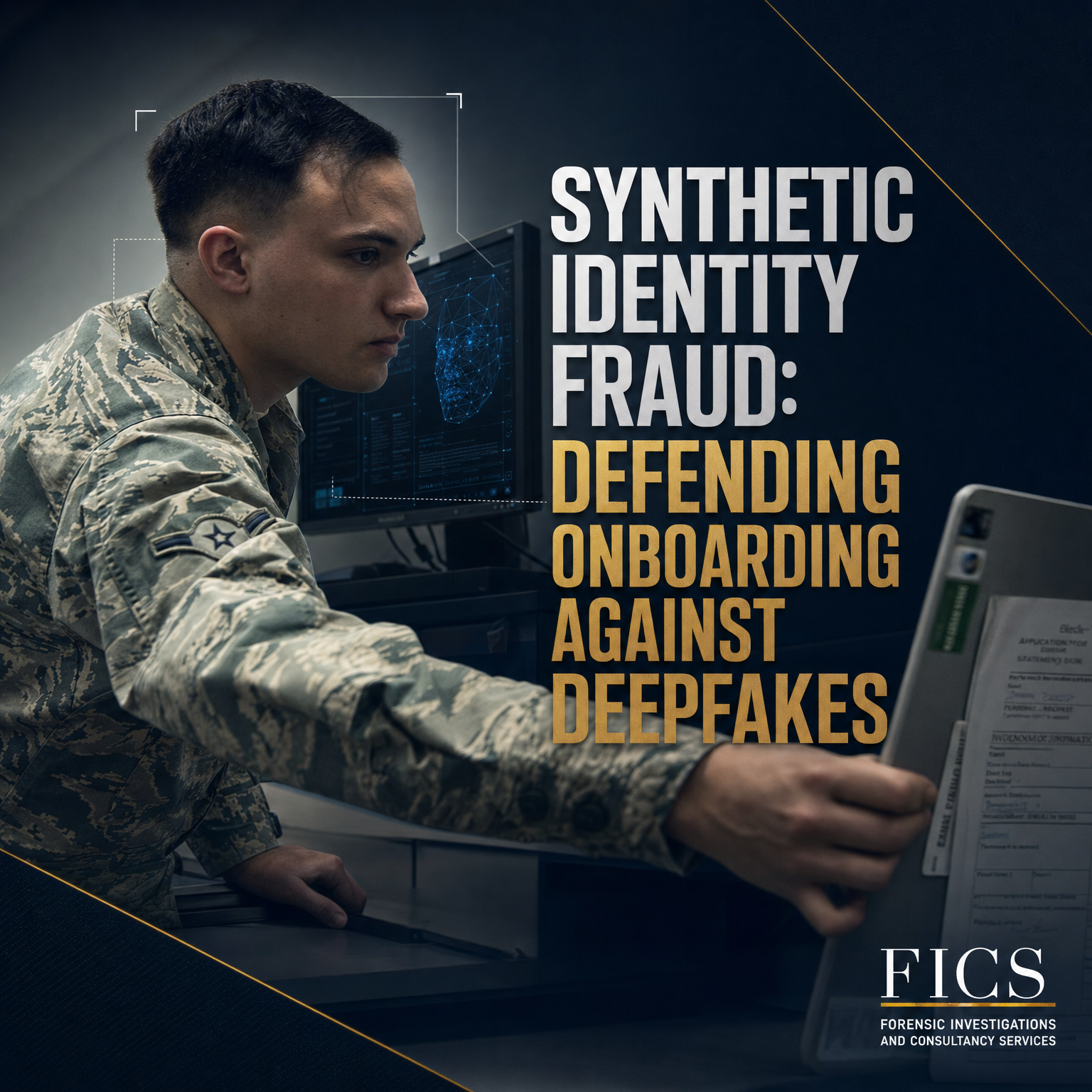
Synthetic Identity Fraud: Defending Onboarding Against Deepfakes
Introduction
Enterprise digital onboarding workflows face a structural crisis. What was once a manageable threat landscape dominated by stolen credentials and doctored document scans has evolved into complex, AI-driven identity warfare. The industry focus has shifted sharply to synthetic media and the systemic infiltration of automated identity verification layers.
Recent industry analyses, including the Proof 2026 Fraud Report, document a severe rise in synthetic identity fraud targeting corporate hiring, financial compliance, and automated Know Your Customer (KYC) channels. Sophisticated threat actors are no longer merely presenting fake physical driver's licenses to webcams. Instead, they inject hyper-realistic generative deepfakes and fabricated synthetic identities straight into raw video feed APIs.
To defend sensitive onboarding pipelines, compliance executives and forensic investigators must look beyond static face-matching technologies. Understanding the technical mechanics of deepfake injection attacks—and deploying rigorous forensic controls—is now essential to maintaining regulatory integrity and enterprise security.
The Infiltration of Identity Verification Layers by Synthetic Media
Standard identity verification relies heavily on two elements: government ID validation and biometric matching paired with passive liveness detection. Attackers now routinely defeat these mechanisms using generative neural networks designed to spoof human micro-expressions, skin light absorption, and dynamic depth cues.
Rather than holding a digital screen in front of a camera, adversaries exploit software-based injection attacks. Utilizing customized browser extensions and virtual camera drivers, threat actors send synthetic video streams directly to the verification server. This technical bypass renders basic optical liveness checks obsolete. Regulatory alerts, such as FinCEN's alert on deepfake media schemes, emphasize that financial institutions and enterprises are facing systematic automated spoofing.
+-------------------+      +-----------------------+      +--------------------------+
| Threat Actor      | ---> | Virtual Camera /      | ---> | Verification API         |
| Generative Engine |      | Injection Driver      |      | (Bypasses Passive Engine)|
+-------------------+      +-----------------------+      +--------------------------+
When evaluating risk across internal systems, enterprise security protocols must extend to remote employee acquisition. Attackers utilize similar synthetic personas to pass remote employment interviews and secure internal access. For organizations assessing HR vulnerabilities, auditing hiring vetting practices helps close dangerous compliance gaps before unauthorized users access corporate networks.
Anatomy of Synthetic Identity Fraud in Enterprise Onboarding
Understanding how synthetic identities are constructed reveals why legacy detection engines miss them. Unlike classic identity theft where an attacker steals an entire real profile, synthetic identity fraud involves combining genuine credentials with entirely fabricated data.
A threat actor might couple a legitimate, unmonitored Social Security Number with an AI-generated face, a disposable VOIP phone number, and a synthetic credit profile. Federal Reserve Bank of Boston research on GenAI identity threats illustrates how generative AI tools allow bad actors to cultivate these Frankenstein identities at scale, establishing realistic digital footprints over months before launching targeted fraud schemes.
Key elements of a modern synthetic onboarding attack include: - Sub-perceptual Deepfake Video: Facial video generated at 60 frames per second with synthetically aligned pupil dilation and micro-blinking. - Hardware-Level Spoofing: Emulation of legitimate mobile device hardware identifiers (IMEI, device fingerprints) to simulate authentic user devices. - Manipulated Data Payloads: Intercepted web payloads where valid document metadata is spliced onto synthetic imagery.
Because these visual outputs look flawless to human reviewers, standard forensic validation requires technical verification behind the image. Relying on simple screen captures is no longer viable, as proven by forensic digital metadata verification protocols required in legal contexts.
Actionable Forensics to Counter Deepfake Onboarding Fraud
Securing identity verification layers requires a defense-in-depth framework that links physical device signals, network telemetry, and deep digital media analysis. Compliance and security teams should immediately implement the following strategies:
- Mandate Active Challenge-Response Liveness: Replace passive liveness checks with randomized, active prompt sequences (e.g., specific head rotations, unpredictable light changes, or micro-phrase vocalizations) that force generative models to render frames in real time.
- Implement Hardware Attestation: Enforce FIDO2 web authentication protocols and strict mobile device attestation (such as Apple DeviceCheck or Google Play Integrity API) to block virtual cameras and software emulators.
- Correlate Telemetry and API Audit Logs: Analyze session latency and incoming stream packet intervals. Synthetic video rendering introduces processing lag that differs distinctly from natural hardware camera feeds.
- Audit Token Usage Against Forensic Logs: Verify that identity verification tokens match authenticated session state parameters by correlating forensic logs with API token usage across the entire application stack.
- Analyze Sub-Surface Optical Artifacts: Deploy advanced forensic classifiers capable of detecting generative AI artifacts, such as inconsistent light scattering in human eye lenses and unnatural chromatic aberration across face boundaries.
Conclusion
Synthetic identity fraud has reached a tipping point, powered by low-cost, high-fidelity generative AI capabilities. Enterprise onboarding pipelines can no longer rely on simple visual checks or legacy document verification software to confirm user authenticity.
Defending identity verification layers against deepfakes demands continuous, multi-layered forensic controls. By combining hardware-level attestations, active dynamic challenge-responses, and deep API log audits, organizations can build robust operational boundaries against synthetic media threats.
To safeguard your onboarding workflows against sophisticated synthetic identity fraud onboarding risks, consult with the forensic technology experts at FICS - Forensic Investigations and Consultancy Services today.