NY DFS $250K Fine: Audit Log Lessons for Financial Institutions
Introduction
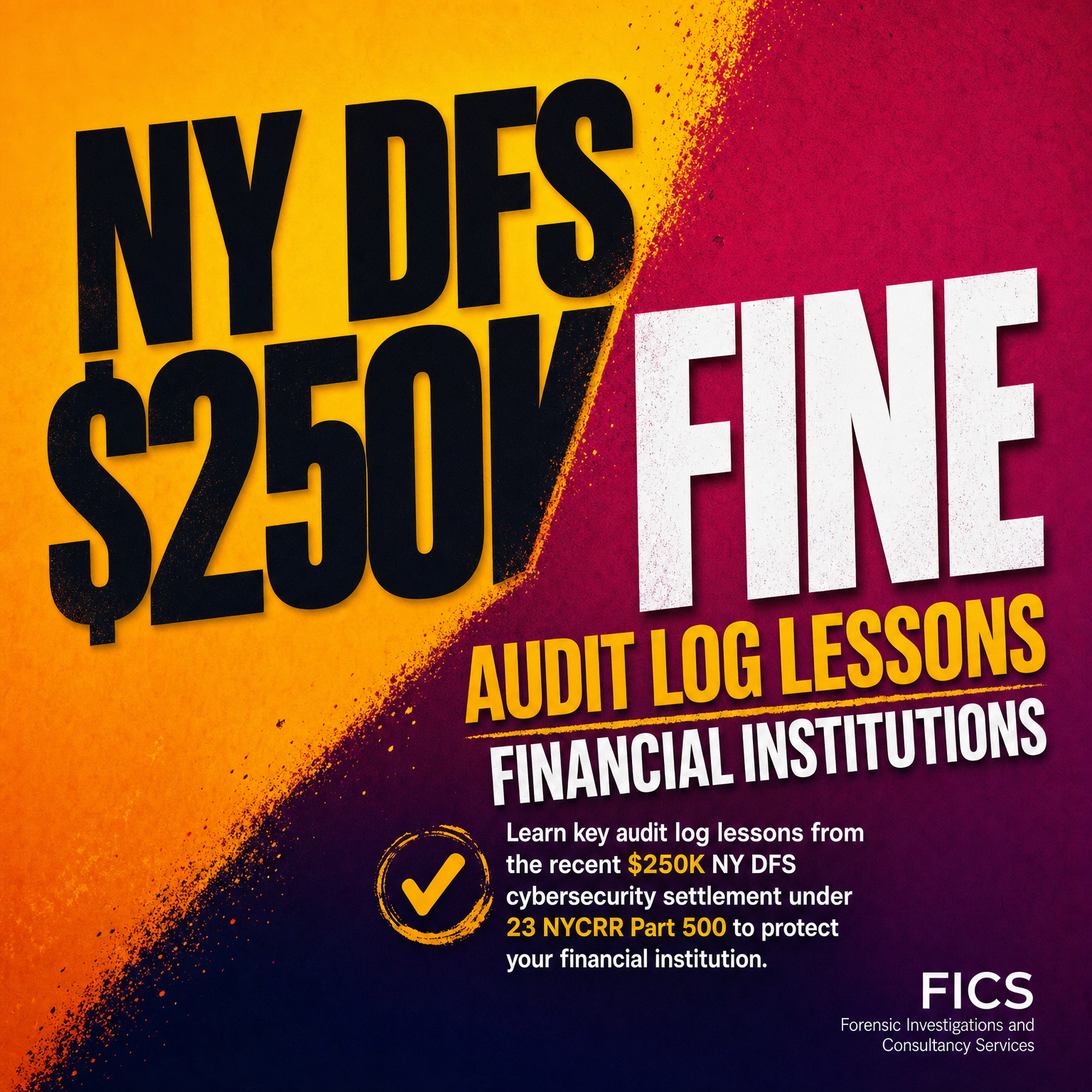
The New York Department of Financial Services (DFS) recently demonstrated its continued focus on enforcement by securing a $250,000 cybersecurity settlement against money transmitter Order Express, Inc. The settlement addresses explicit violations of 23 NYCRR Part 500 regulations, state standards designed to enforce robust cybersecurity posture for covered entities.
This enforcement action highlights a persistent issue in institutional defense: incomplete, unmonitored, or poorly retained audit logs. When threat actors breach corporate networks, incomplete audit logs severely restrict forensic investigations. Regulators view inadequate logging not merely as a technical oversight, but as an operational compliance failure.
Financial institutions must recognize that audit logs serve as the primary source of truth during an incident response engagement. Without proper logging, proving regulatory compliance and determining the scope of compromised data becomes nearly impossible.
Key Takeaways from the NY DFS $250K Enforcement Action
The regulatory action against Order Express underscores that cybersecurity compliance requires continuous, verified technical controls rather than passive policies on paper. Details published by the NY DFS Cybersecurity Resource Center clarify that covered organizations must maintain proactive security oversight.
Regulators cited critical technical gaps during the investigation. Primary among these was the inability to reconstruct system access events due to missing telemetry. The enforcement details published in industry analysis of the NY DFS $250K fine highlight how gaps in security tracking compound existing risk exposure.
Key compliance failures identified in this action include: - Inadequate Audit Trail Retention: Failure to store access and system event records for required operational windows. - Access Control Monitoring Gaps: Deficiencies in tracking privilege escalation and administrative logons. - Delayed Incident Reconstruction: The inability to promptly provide forensic teams with immutable event data following initial compromise detection.
When adversaries compromise authentication systems or steal baseline credentials—similar to attacks where INC Ransomware Steals MFA Seeds—reliable audit logs are the only mechanism that allows responders to map lateral movement.
NY DFS Audit Log Requirements: What Regulators Expect
Section 500.06 of 23 NYCRR Part 500 mandates that financial institutions maintain systems designed to reconstruct financial transactions and preserve detailed security event logs. Meeting these NY DFS audit log requirements requires deliberate technical engineering and continuous log validation.
Regulators expect financial organizations to maintain complete record integrity across several core security event categories: - Privileged User Activities: Every action taken by domain administrators, system engineers, and automated service accounts must generate audit events. - Authentication Events: Successful login actions, multi-factor authentication (MFA) prompts, and failed access attempts must be tracked continuously. - System Configuration Changes: Firewall modifications, policy changes, and access list additions require timestamped log entries. - Data Export Events: Financial databases and file shares must log file access and bulk download activities to spot exfiltration vectors.
In modern environments, security teams frequently use automated tooling or AI assistants to review custom code. Security engineers conducting automated analysis must verify that custom monitoring tools do not accidentally bypass system audit policies, as detailed in our guide on Anthropic AI Code Audits.
5 Practical Steps to Ensure Audit Trail Integrity
To avoid costly regulatory penalties and ensure incident readiness, financial institutions should implement these five concrete defensive controls:
- Centralize Log Collection with Immutability: Ship active system logs immediately to a centralized Security Information and Event Management (SIEM) platform. Use Write-Once-Read-Many (WORM) storage architecture to prevent attackers from altering records.
- Monitor for Log Tampering: Implement automated alerts for service stops or log deletion commands. Attackers often abuse specialized software to erase evidence, a tactic highlighted when defenders learn to Detect Abused DFIR Tools.
- Enforce Complete NTP Synchronization: Synchronize system clocks across all network endpoints using secure Network Time Protocol (NTP) servers. Timestamps must align precisely to allow accurate cross-system event correlation during forensics.
- Define Log Retention Policies explicitly: Configure log retention policies to retain active records for at least one year, with secondary offline storage configured to satisfy industry-specific statutory requirements.
- Conduct Regular Forensic Audits: Perform quarterly log review exercises to ensure critical endpoints, cloud instances, and databases emit standardized logs that ingest cleanly into your monitoring tools.
Conclusion
The $250,000 NY DFS penalty serves as a direct reminder that cybersecurity compliance is enforced through verifiable technical controls. Meeting 23 NYCRR Part 500 compliance standards requires organizations to maintain complete, secure, and continuously monitored audit trails across all IT assets.
Without structured audit log management, financial entities face elevated regulatory liability and increased incident costs during a breach. Proactive log preservation is essential to operational resilience and compliance integrity.
At FICS - Forensic Investigations and Consultancy Services, our team delivers deep forensic readiness reviews, regulatory compliance assessments, and digital investigation services. Contact FICS today to evaluate your audit logging controls and ensure your network meets NY DFS standards before an incident occurs.