Introduction
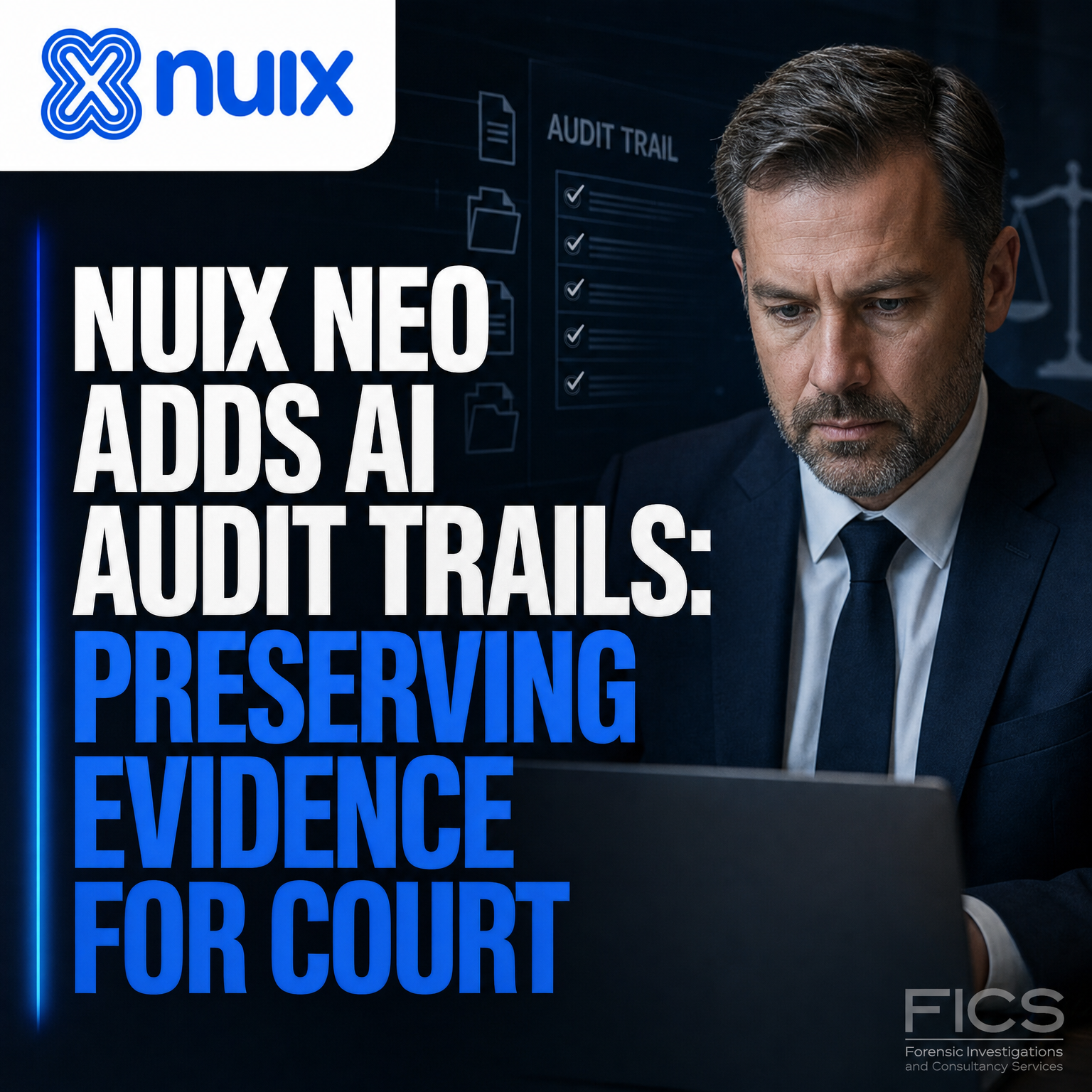
In a major milestone for legal technology and corporate investigations, Nuix announced the integration of agentic AI into its flagship platform with a built-in forensic audit trail on October 21, 2026. According to the official Nuix launch announcement, the updated Nuix Neo platform empowers investigators to deploy autonomous, multi-step AI agents while maintaining total transparency over how conclusions are derived.
For forensic practitioners and legal teams, this development addresses a long-standing paradox in modern litigation: while artificial intelligence drastically reduces the time required to analyze terabytes of unstructured data, unvetted "black box" AI workflows frequently fail strict court admissibility standards. Without a granular, immutable log detailing every decision path the software took, trial attorneys cannot defend AI-assisted findings against evidentiary challenges.
At Forensic Investigations and Consultancy Services (FICS), we scrutinize every technological advancement through the lens of courtroom admissibility. Nuix Neo’s addition of verifiable audit logs marks a pivotal shift, bridging the gap between cutting-edge computational speed and the stringent evidentiary requirements enforced by modern judges.
Forensic AI Audit Trails and Court Admissibility
When introducing digital evidence in civil or criminal litigation, proving chain of custody and methodological reliability is paramount. Federal Rule of Evidence 702 and landmark precedents like Daubert v. Merrell Dow Pharmaceuticals require expert witnesses to demonstrate that their analytical methods are scientifically valid and consistently repeatable.
When legal teams rely on opaque generative models, opposing counsel can easily challenge the testimony. As explored in our analysis on spotting unvetted GenAI in court, unverified algorithms often introduce hallucinated context or unexplained data omissions that disqualify expert reports.
The Nuix Neo AI audit trail directly counters this vulnerability by systematically recording: - Exact Prompt Inputs: The exact queries, context parameters, and instructions provided to autonomous agents. - Decision Pathways: Step-by-step logs showing how the agent navigated complex dataset trees and prioritized specific file types. - Model Parameters: Version control metrics, including specific LLM endpoints and temperature settings used during processing. - Output Timestamps: Cryptographically verified time logs linking specific findings directly to targeted raw evidence sources.
By maintaining this continuous chain of record, digital forensics examiners can reconstruct an agentic workflow months or years after the initial analysis.
Agentic AI in Digital Forensics: Defending Methodologies in Litigation
Traditional eDiscovery relies heavily on manual keyword filters and linear technology-assisted review (TAR). In contrast, agentic AI in digital forensics can execute multi-step reasoning—synthesizing context across emails, chat logs, and encrypted file systems simultaneously to identify hidden fraud or data exfiltration schemes.
However, advanced reasoning creates sophisticated legal risks if the underlying steps remain unrecorded. Forensic examiners must never confuse internal application logs with legally binding evidence. Much like relying solely on standard system logs can be misleading—as detailed in our guide on why SIEM logs alone do not prove employee fraud—raw AI output summaries without forensic validation fall short under strict cross-examination.
Consider a corporate espionage investigation involving 500,000 internal documents. An agentic AI within Nuix Neo might identify an executive transferring proprietary source code to a personal cloud drive. With the platform's built-in forensic audit trail, the FICS investigation team can present the judge with an explicit record showing precisely how the AI correlated user access timestamps with encrypted file movements, proving that no critical context was skipped or distorted during parsing.
5 Protocols for Preserving AI Evidence for Court
To ensure AI-assisted investigative findings remain fully admissible during litigation, litigation teams and forensic experts should follow these essential protocols:
- Audit Vendor and Tool Integrity: Before deploying automated platforms, verify that the vendor adheres to strict forensic standards. Ensure vendor software does not blend your proprietary evidence with open external training sets, mirroring principles necessary when legal counsel must audit vendor integrity and compliance.
- Lock and Archive Model Versioning: Always document the exact software release, agentic model version, and underlying architecture used during processing to enable third-party replication.
- Export Native Audit Logs Immediately: Upon concluding an AI-driven review session, export the native cryptographic audit trail to read-only, write-once media alongside raw digital image files.
- Pair AI Insights with Hard Forensic Artifacts: Treat agentic AI discoveries as investigative leads. Cross-reference every automated finding against system memory, master file tables (MFT), or physical device artifacts.
- Prepare Methodological Disclosures Early: Draft comprehensive disclosures outlining the scope of AI utilization, prompt structures, and validation protocols prior to pre-trial evidentiary hearings.
Conclusion
The release of agentic AI within the Nuix Neo platform represents a major evolution in legal technology. By embedding a built-in Nuix Neo AI audit trail, Nuix provides the defensibility required to take advanced computational discoveries into the courtroom with complete confidence.
As corporate datasets continue to expand, leveraging autonomous AI will become standard practice across complex investigations. However, speed must never come at the expense of evidentiary integrity. Implementing strict preservation workflows ensures that your digital evidence withstands intense judicial scrutiny.
At FICS, our senior digital forensics and expert witness consultants specialize in navigating complex, AI-driven investigations. Contact our forensic team today to learn how we can audit your eDiscovery processes, preserve critical digital evidence, and defend your technical methodologies in court.