INC Ransomware Steals MFA Seeds: Forensic Response Plan
Introduction
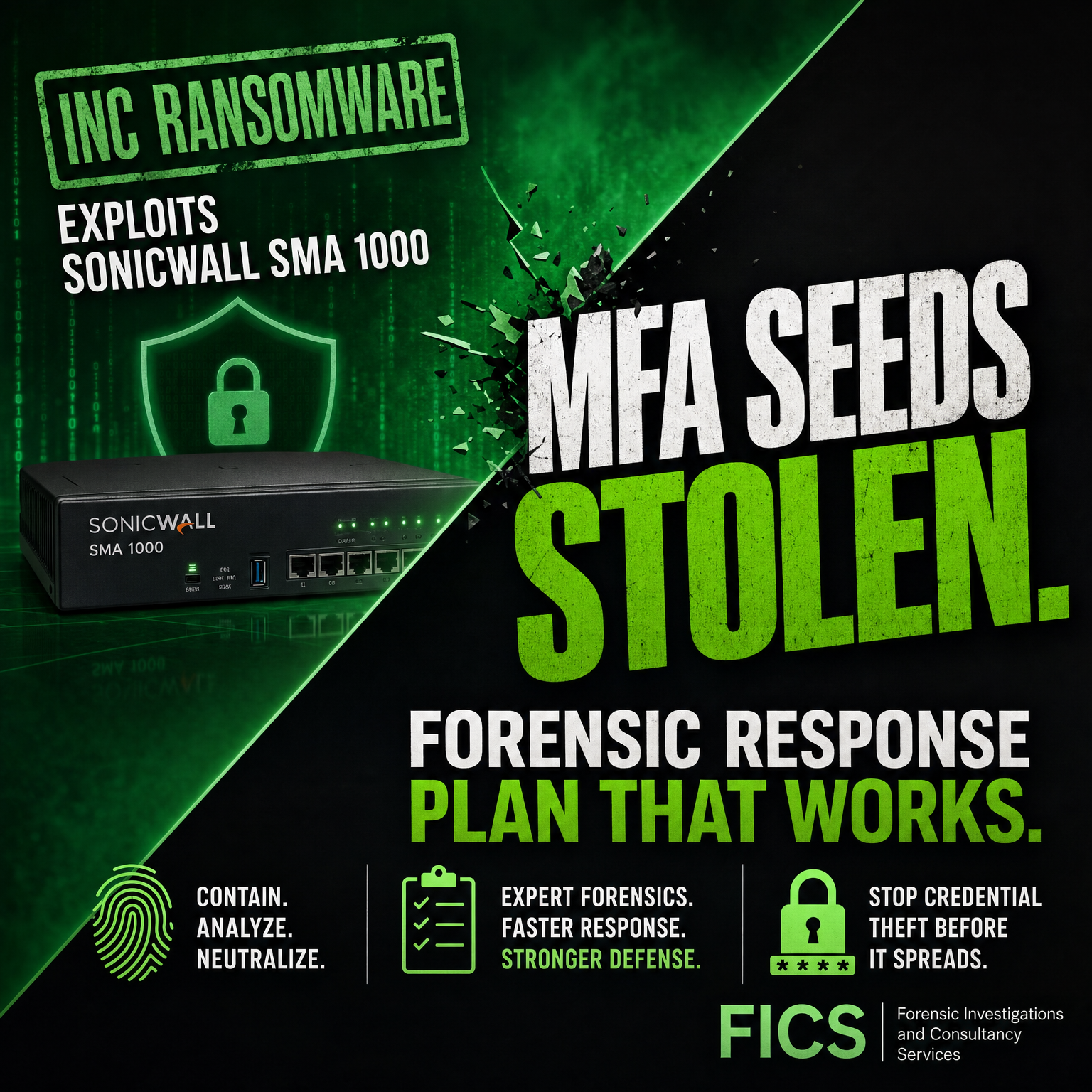
On August 3, 2026, The Hacker News confirmed a critical escalation in threat actor capabilities: the INC Ransomware group is actively exploiting zero-day and unpatched vulnerabilities within SonicWall Secure Mobile Access (SMA) 1000 series appliances to extract Multi-Factor Authentication (MFA) seeds and user credentials.
This development represents a fundamental shift in corporate exposure. Multi-Factor Authentication has long been treated as the ultimate defensive perimeter for remote access gateway devices. However, when threat actors bypass the authentication interface to extract raw Time-based One-Time Password (TOTP) secret seeds directly from appliance storage or active memory, the security guarantee of MFA collapses entirely. An attacker possessing both user credentials and secret MFA seeds can clone authentication tokens locally, gaining persistent, authorized remote access without triggering secondary challenge anomalies.
For security operations teams and C-level executives, this incident demands an immediate transition from traditional perimeter defense to aggressive digital forensics and identity containment. FICS - Forensic Investigations and Consultancy Services has developed this forensic response plan to guide impacted organizations through investigating, containing, and remediating INC Ransomware MFA seeds exfiltration incidents.
Deconstructing the SonicWall SMA 1000 Exploit Mechanics
To contain this threat effectively, security teams must understand how INC Ransomware operators extract critical identity artifacts from gateway appliances.
The SonicWall SMA 1000 series serves as a central SSL-VPN gateway, managing authenticated user sessions, local user databases, and third-party identity integrations. By executing code vulnerabilities against unpatched appliances, INC Ransomware threat actors gain elevated root permissions on the underlying operating system.
[Attacker] ---> (Exploits SonicWall SMA 1000 Vulnerability)
                       |
                       v
         [Root Access to Gateway Appliance]
                       |
        +--------------+--------------+
        |                             |
        v                             v
[Extract Passwords]          [Extract MFA Seeds]
        |                             |
        +--------------+--------------+
                       |
                       v
    [Local TOTP Clone Generated on Attacker Device]
                       |
                       v
    [Unrestricted Persistence & MFA Bypass]
Once administrative elevation is achieved, attackers execute specialized post-exploitation scripts to harvest:
- Plaintext and hashed credentials cached in active session memory (lsass equivalents or appliance runtime daemons).
- TOTP secret seeds stored in configuration files or active memory state databases.
- Active session tokens and cookies, enabling immediate session hijacking without initial authentication prompts.
The key risk here is stealth persistence. Standard incident response playbooks often focus on resetting active user directory passwords. However, if an enterprise resets Active Directory passwords without revoking and regenerating the underlying TOTP MFA seeds, the attacker retains the ability to calculate correct 6-digit dynamic passcodes on their own hardware, effectively neutralizing standard password reset enforcement.
Digital Forensics Response Protocol for Compromised MFA Seeds
When responding to an alleged or confirmed SonicWall SMA 1000 intrusion involving INC Ransomware, standard disk imaging is insufficient. FICS recommends a tailored four-phase forensic protocol:
Phase 1: Volatile Memory Capture and Appliance Preservation
Before rebooting or patching the SonicWall appliance, capture physical volatile memory (RAM) and diagnostic logs. Rebooting clears active execution states, erasing proof of lateral movement, active shell sessions, and transient memory-resident malware payloads utilized by INC Ransomware operators.
Phase 2: Telemetry Reconstruction and Log Audit
Forensic examiners must aggregate authentication logs from both the VPN gateway and backend Identity Providers (IdPs) such as Microsoft Entra ID or Okta. Search for the following indicators:
- Geographic Anomaly Matching: Simultaneous logins utilizing identical credentials and valid MFA tokens from disparate geographic IP addresses.
- API and Process Spawns: Uncharacteristic shell executions (/bin/sh, python instances, or unexpected binary modifications) on the SMA appliance runtime directory.
- Configuration Modifications: Bulk exports or automated reads of local configuration databases (e.g., SQLite files storing TOTP secrets).
Phase 3: Identity Provider Audit
Examine backend directory controller logs to trace downstream activity. Identify all accounts that authenticated via the compromised SonicWall gateway during the exposure window and map their internal movements across internal SMB, RDP, and LDAP channels.
6-Step Actionable Remediation and Hardening Strategy
If your organization utilizes SonicWall SMA 1000 appliances or suspects exposure to INC Ransomware tactics, implement these immediate containment steps:
- Isolate and Patch Appliance Firmware: Instantly apply vendor-provided emergency patches for the SonicWall SMA 1000 series. If patching cannot occur immediately, restrict ingress gateway access exclusively to trusted explicit IP ranges.
- Invalidate and Re-key ALL MFA Seeds: Perform a mandatory global reset of TOTP secret keys across all affected user populations. Do not simply enforce a password reset; force users to re-enroll modern secondary authentication factors from scratch.
- Revoke Active Enterprise Sessions: Execute an enterprise-wide session invalidation across Active Directory, Microsoft Entra ID, Okta, and internal VPN controllers to terminate cloned attacker session tokens immediately.
- Transition to FIDO2 / Passkey Authentication: Phish-resistant hardware tokens (such as YubiKeys or FIDO2-compliant passkeys) do not rely on static shared TOTP secrets stored on central gateways, rendering MFA seed extraction techniques useless.
- Conduct Endpoint Threat Hunting: Deploy Endpoint Detection and Response (EDR) agents in isolation mode across critical internal assets to detect post-exploitation tools, shadow admin creation, or credential dumping associated with INC Ransomware.
- Engage External Forensic Experts: Retain a specialized digital forensics firm to verify that threat actors have not established secondary backdoors (such as malicious Web shells or compromised service accounts) prior to returning systems to production.
Conclusion
The active exploitation of SonicWall SMA 1000 devices by INC Ransomware demonstrates that modern cybercriminals no longer view Multi-Factor Authentication as an insurmountable barrier. By stealing underlying MFA seeds, attackers can bypass traditional security controls with ease.
Organizations must adapt by shifting away from vulnerable shared-secret authentication architectures toward robust, phish-resistant identity frameworks. When an identity breach of this magnitude occurs, fast, precise forensic intervention is essential to prevent operational downtime and complete network takeover.
FICS - Forensic Investigations and Consultancy Services stands ready to assist enterprise security operations. Our elite digital forensics and incident response teams specialize in complex threat hunting, identity architecture remediation, and rapid containment of advanced ransomware actors. Contact FICS immediately to secure your environment and mitigate enterprise cyber risk.