Forensic Logs vs API Tokens: Closing the 33% Identity Audit Gap
Introduction
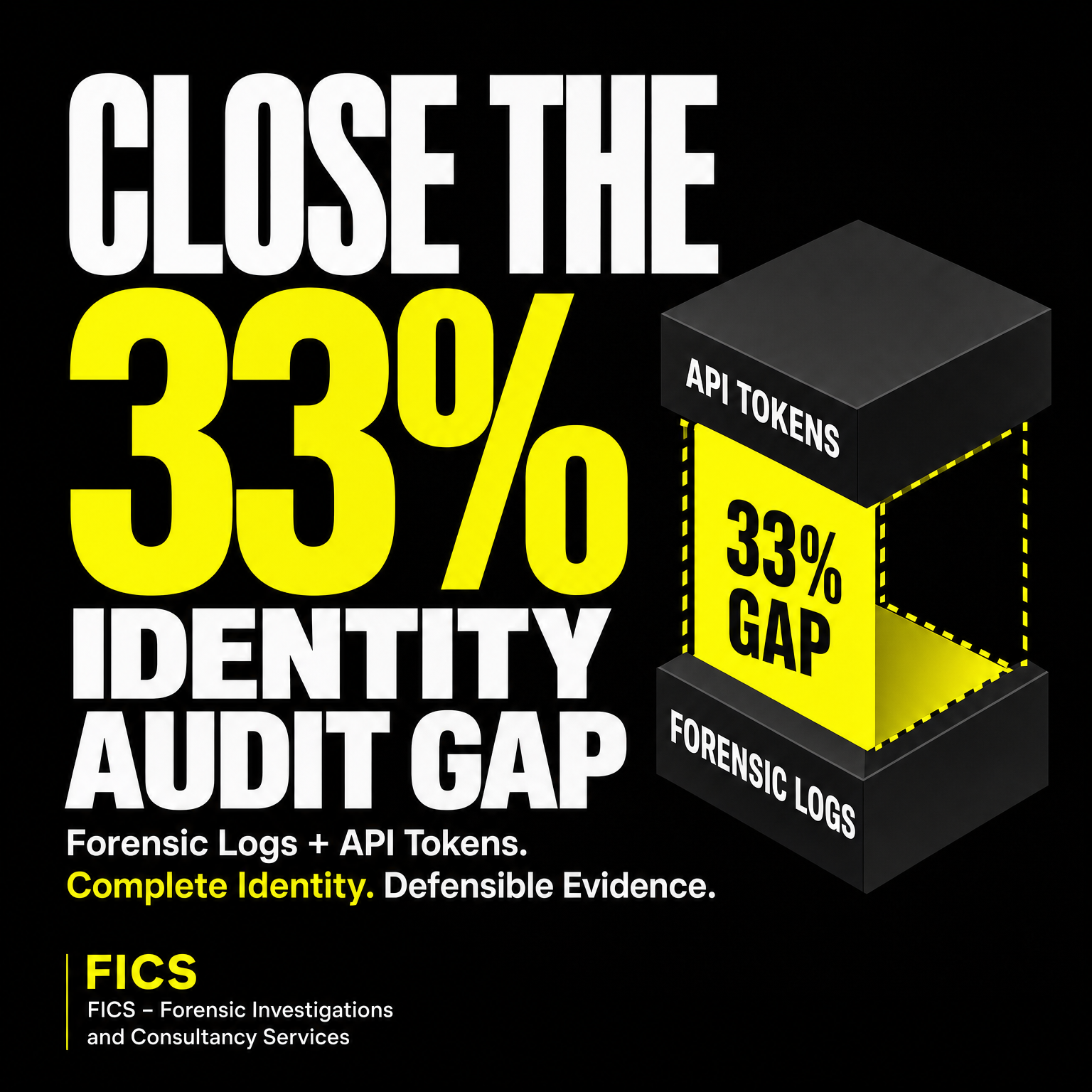
According to the 2026 Enterprise Identity Audit Benchmark, 82% of enterprise organizations undergo formal identity audits annually. However, 33% of those organizations are unable to satisfy regulatory standards because they rely exclusively on standard API token telemetry. This mismatch creates a severe vulnerability known as the Identity Audit Gap.
When external regulators or internal compliance teams demand evidence, traditional application access logs frequently fall short. Standard API logs show that a specific OAuth token or service account key made an endpoint request, but they fail to prove whether that token was legitimately issued, hijacked via token replay, or modified in transit.
To satisfy stringent legal and regulatory mandates, enterprises must move beyond superficial token tracking. This article breaks down the architectural differences between API tokens and forensic logs, offering a concrete decision framework to eliminate identity audit gaps once and for all.
Understanding the Identity Audit Gap: Forensic Logs vs API Tokens
The core issue behind the identity audit gap lies in the distinction between operational identity verification and forensic non-repudiation. Modern microservices and cloud workloads rely heavily on non-human identities (NHIs) such as API keys, OAuth tokens, and automated service principals.
Standard API token logs capture transactional activity: HTTP methods, response codes, IP addresses, and bearer token identifiers. While adequate for daily operational troubleshooting, this telemetry lacks the cryptographic rigor required for legal defensibility. As highlighted in a recent Cloud Security Alliance report on non-human identities, the exponential growth of NHIs has outpaced conventional logging tools, leaving security teams blind to credential abuse.
[Standard API Log]  ---> Captures: Timestamp + IP + Status Code + Token ID
                          Risk: Tamperable, lacks payload context, no non-repudiation.

[Forensic Identity Log] ---> Captures: Payload Hash + Token Lifecycle + Signature Verification
                          Benefit: Cryptographically immutable, legally defensible, zero gap.
When an incident occurs or an auditor requests proof of identity assurance, standard logs cannot prove that the record itself was not altered after the fact. Without cryptographic hashing and secure metadata preservation, standard logs fail key court admissibility standards—a risk detailed in our analysis on verifying digital metadata.
Forensic logs, by contrast, capture the entire lifecycle of an identity transaction. They record token issuance, claim delegation, cryptographic assertion signatures, and full payload hashes.
Decision Framework: Evaluating Identity Audit Evidence Requirements
Choosing between basic API token logging and forensic-grade identity logging is not a matter of subjective preference. It is a structural compliance decision governed by regulatory scope, data sensitivity, and threat profile.
Use the following framework to decide which architecture your organization must enforce:
| Criterion | Standard API Token Logs | Forensic Identity Logs |
|---|---|---|
| Audit Suitability | Internal operational metrics only | Regulated compliance & legal defense |
| Integrity Protection | Vulnerable to administrator tampering | Cryptographically sealed (WORM storage) |
| Non-Human Identity Tracking | Limited to token ID strings | Tracks refresh chains & delegation paths |
| Non-Repudiation | Low (cannot prevent token forgery claims) | High (proves precise payload & assertion) |
| Implementation Overhead | Minimal (default gateway capability) | Moderate (requires key management & storage) |
The Non-Negotiable Rule for Security Leaders
Do not default to standard API logs for mission-critical workflows. Apply this decision rule:
- Mandate Forensic Logs if: Your enterprise operates in regulated sectors (finance, healthcare, defense), handles sensitive customer PII, or manages API workflows subject to external oversight. This is aligned with the NIST IR 8587 guidelines for token protection and assertion integrity. Furthermore, regulatory precedents demonstrate that insufficient logging leads directly to enforcement penalties, as seen in recent audit log compliance lessons.
- Use Standard API Token Logs only if: The endpoint processes non-sensitive, read-only public data where an identity breach carries zero legal liability or regulatory risk.
Actionable Steps to Eliminate Your Identity Audit Gap
To bridge the 33% gap and maintain court-admissible audit trails, implement these six technical controls:
- Bind Token Issuance to Immutable Forensic Storage: Configure your identity provider (IdP) to output token issuance, revocation, and scope expansion events directly to Write-Once-Read-Many (WORM) storage.
- Cryptographically Hash Request Payloads: Pair incoming API tokens with SHA-256 hashes of the request body to ensure attackers cannot alter request parameters post-execution.
- Audit Non-Human Identity Delegation Paths: Map every automated service account and short-lived token to its parent identity to preserve explicit chain-of-custody.
- Enforce Token Binding Protocols: Use Mutual TLS (mTLS) or Demonstration of Proof-of-Possession (DPoP) to ensure stolen bearer tokens cannot be reused on unauthorized endpoints.
- Eliminate Evidence Preservation Gaps: Align your logging policies with standardized evidentiary frameworks to ensure records hold up under formal scrutiny, avoiding common digital evidence handling gaps.
- Automate Continuous Integrity Auditing: Run daily automated checks comparing log digest hashes against secondary key vaults to instantly flag evidence tampering.
Conclusion
Relying on standard API token metadata for identity verification creates a false sense of security. While standard logs satisfy basic developer needs, they consistently fail under the pressure of formal compliance audits and legal discovery.
Closing the 33% Identity Audit Gap requires a deliberate shift to forensic-grade logging. By capturing cryptographic assertions, preserving chain-of-custody metadata, and enforcing strict WORM storage controls, organizations can transform vulnerable API logs into legally defensible evidence.
If your enterprise faces upcoming compliance evaluations or complex digital investigations, do not leave your identity evidence to chance. Contact FICS - Forensic Investigations and Consultancy Services to audit your evidence architecture and fortify your digital footprint.