Interlock Gang Weaponizes DFIR Tools: How to Detect Abused Software
Introduction
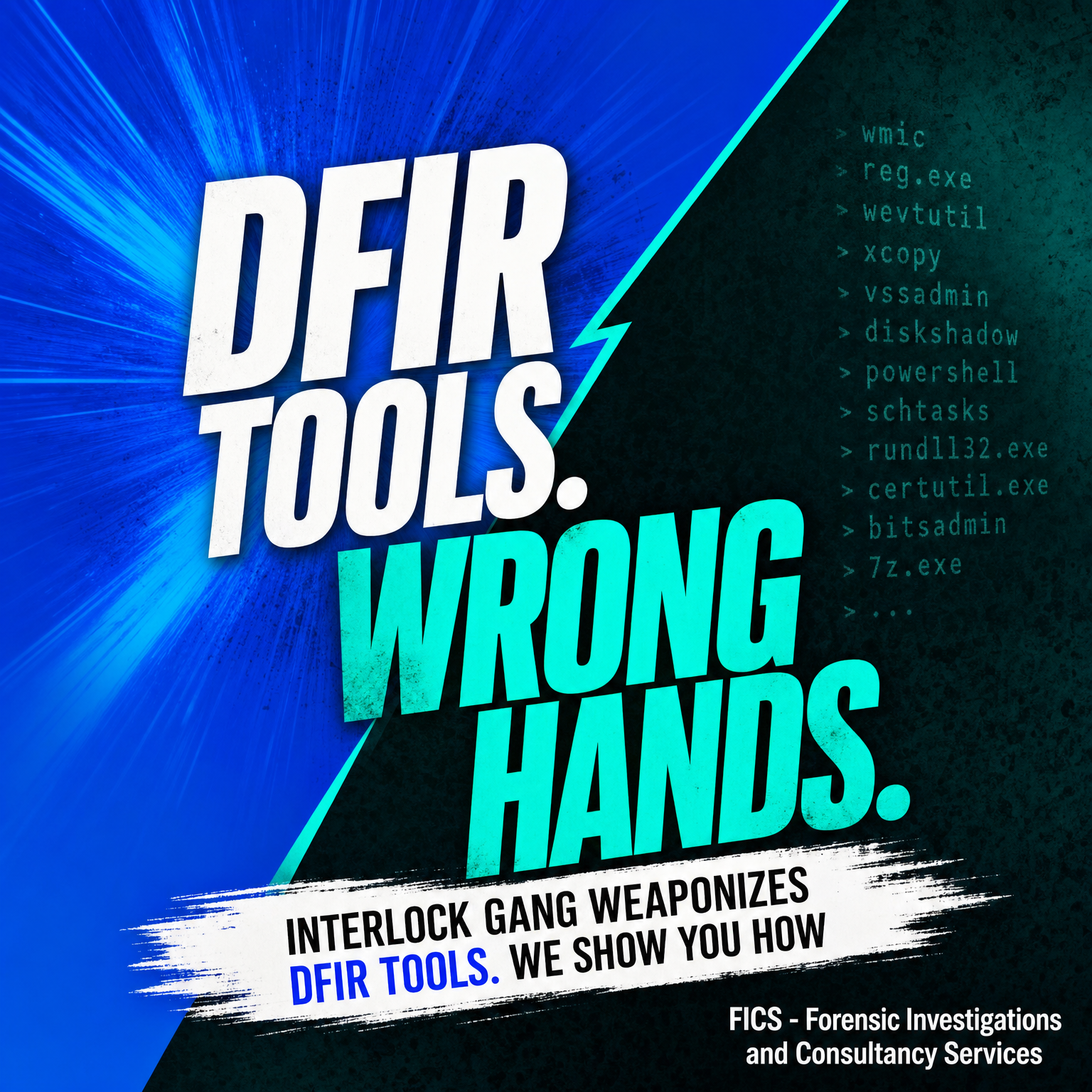
On August 4, 2026, cybersecurity researchers at Sophos News exposed a critical shift in modern ransomware operations: the Interlock ransomware gang was observed weaponizing legitimate Digital Forensics and Incident Response (DFIR) tools alongside Remote Monitoring and Management (RMM) utilities during active intrusions. Rather than relying solely on proprietary malware or unpatched zero-day exploits, Interlock operators turned trusted defensive software into covert attack platforms.
This "living off the land" methodology presents a severe challenge for enterprise defenders. When cybercriminals leverage the exact forensic tools security teams use to investigate breaches, standard signature-based security controls often fail to trigger alerts. Trusted binaries execution combined with legitimate elevated privileges allows threat actors to establish persistence, map network assets, and exfiltrate data while hiding in plain sight.
At FICS (Forensic Investigations and Consultancy Services), our threat response specialists emphasize that surviving this evolving threat landscape requires shifting from binary signature reliance to deep context-aware detection. To protect your enterprise, you must understand how adversaries hijack administrative trust and implement continuous controls to detect abused DFIR tools across your fleet.
The Threat: How Interlock Abuses DFIR and RMM Software
The Sophos investigation detailed how Interlock threat actors deployed administrative and forensic software during live compromise chains. By introducing dual-use command-line utilities, commercial memory acquisition software, and remote control agents into targeted environments, the operators successfully conducted internal reconnaissance and privilege escalation without alarming Security Operations Center (SOC) analysts.
Adversaries prefer weaponizing legitimate DFIR and RMM software for three operational reasons:
- Elevated Privileges by Design: DFIR utilities naturally require kernel-level or SYSTEM access to acquire physical memory, inspect raw disk volumes, and read protected security logs. When attackers launch these tools, they instantly gain deep system visibility.
- Bypassing EDR Whitelists: Enterprise security policies frequently exempt approved forensic and management tools from aggressive blocking rules. Interlock takes advantage of these EDR exclusions to execute code unimpeded.
- Obfuscated Network Traffic: Abused RMM suites communicate over standard HTTPS protocols to established cloud infrastructures, effectively masking command-and-control (C2) communication within normal administrative traffic.
This tactic mirrors wider industry trends where threat actors exploit foundational IT and security components to gain initial traction. For instance, when analyzing advanced intrusion playbooks—much like how INC Ransomware Steals MFA Seeds: Forensic Response Plan illustrates the systematic compromise of authentication architecture—the goal remains consistent: exploit defender trust to accelerate data exfiltration before encryption begins.
Detection Strategies: Identifying Rogue Tool Usage
To successfully detect abused DFIR tools, security teams must analyze execution behavior, command-line arguments, and environment contexts rather than relying on file hashes.
Behavioral Anomalies and Execution Context
Legitimate forensic activities follow strict change-management procedures and incident response ticket workflows. An unexpected forensic utility execution—such as FTK Imager, Volatility, or custom memory dump tools—running outside an active, documented incident ticket is an immediate indicator of compromise (IOC). Security teams should closely monitor execution paths; legitimate responders run tools from protected security repositories or admin shares, whereas threat actors frequently stage utilities in C:\Users\Public\, C:\Windows\Temp\, or user Downloads folders.
Parent-Child Process Lineage
Inspecting process relationships is crucial. A DFIR utility launched directly by an interactive domain admin session during an approved maintenance window is normal. However, if a forensic binary is spawned by cmd.exe, powershell.exe, or an unauthorized RMM service account, it indicates automated or malicious lateral movement.
Network Telemetry Correlation
While DFIR tools are designed for local data collection or saving artifacts to a local network share, weaponized variants or scripts orchestrated by threat actors may stream data out to unrecognized IP addresses or cloud storage providers. Correlating host execution logs with network proxy and firewall logs reveals anomalous egress associated with tool misuse.
Actionable Strategies to Safeguard Your Infrastructure
Securing your network against dual-use tool abuse requires proactive administrative controls and rigorous behavioral monitoring. Security teams should implement the following defensive actions immediately:
- Implement Strict Application Control: Utilize Windows Defender Application Control (WDAC) or AppLocker to block unauthorized administrative and forensic binaries across standard user workstations.
- Audit EDR Exclusions Regularly: Remove broad folder or binary exclusions in your EDR platform. Require explicit hashes and path sign-offs for allowed diagnostic utilities.
- Enforce Just-in-Time (JIT) Privileged Access: Ensure administrative and forensic utilities can only execute under temporary, heavily audited privilege sessions rather than standing administrator accounts.
- Monitor Command-Line Telemetry: Enable Command-Line Process Auditing (Event ID 4688) and Script Block Logging (Event ID 4104) to flag suspicious parameters (e.g., automated memory dumping commands).
- Establish Dedicated Responder Hardware: Ensure legitimate incident response tools are maintained on segregated, hardened forensic jump boxes rather than stored on general enterprise servers.
- Deploy Canary Files and Honeytokens: Place dummy credential files or fake memory dumps on key servers to catch unauthorized forensic collection scripts in the act.
Conclusion
The Sophos discovery of the Interlock gang's reliance on abused DFIR and RMM software underscores a modern reality: threat actors no longer need custom rootkits when native, trusted software can do the job for them. By exploiting the inherent permissions granted to diagnostic software, attackers blur the line between normal administration and active cyber incidents.
Defending against these evasive tactics demands continuous behavioral hunting and strict execution constraints. Organizations that establish baseline visibility over administrative workflows will be best equipped to detect abused DFIR tools before adversaries finalize their extortion campaigns.
At FICS (Forensic Investigations and Consultancy Services), we help organizations build resilient threat-hunting capabilities, analyze complex forensic artifacts, and mitigate advanced adversary tactics. Contact our forensic consulting team today to conduct a thorough compromise assessment and fortify your enterprise against modern ransomware operations.