Introduction
Generative AI platforms have rapidly integrated into daily corporate workflows, serving as virtual research assistants, code review partners, and draft writers. However, enterprise adoption has outpaced traditional legal discovery governance. A pivotal ruling from the U.S. District Court for the Southern District of Florida has formally established that corporate artificial intelligence interaction logs are subject to mandatory civil discovery.
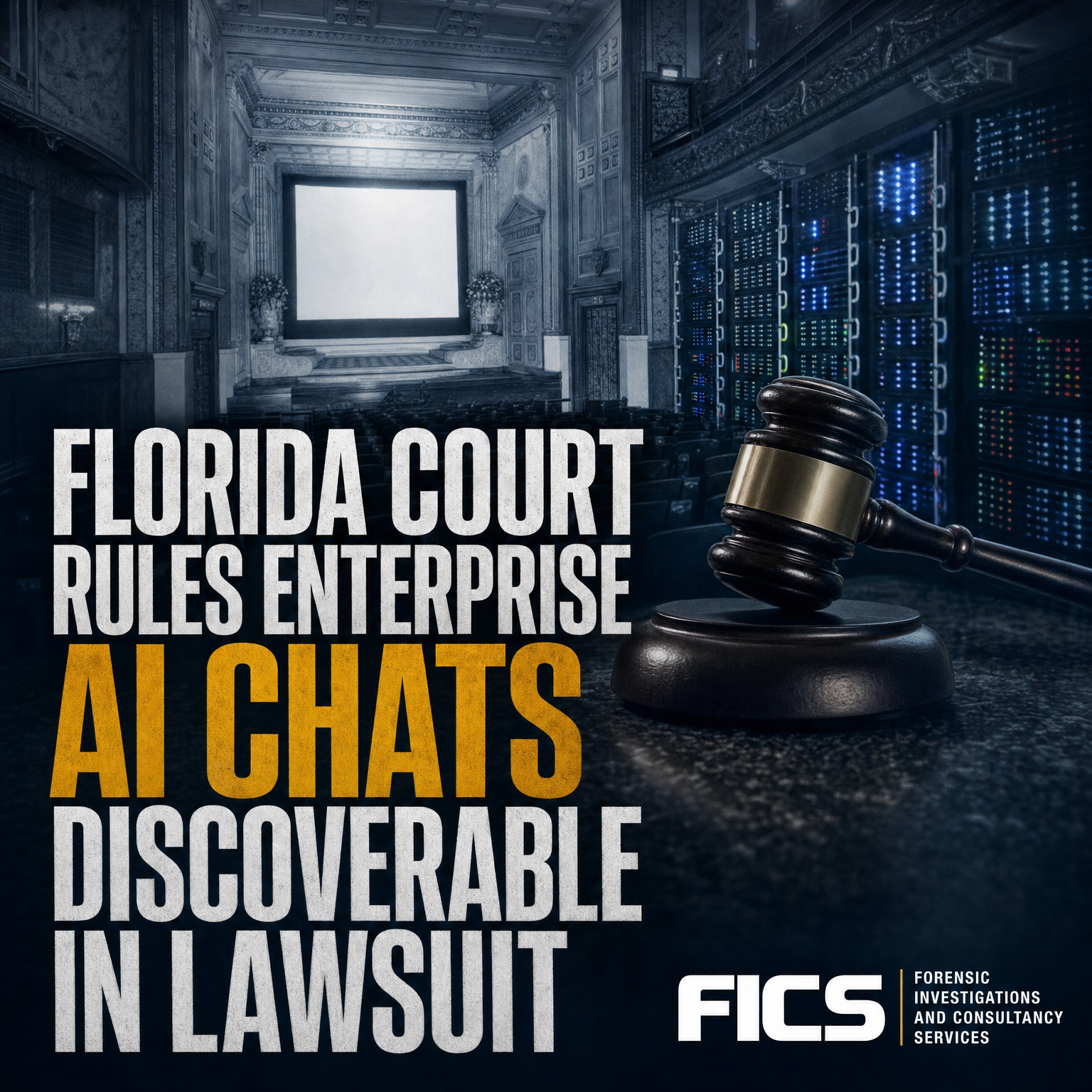
In Fontainebleau Florida Hotel v. Botach (analyzed by RumbergerKirk), the court ruled that conversation transcripts and prompt histories maintained within enterprise AI platforms qualify as discoverable Electronically Stored Information (ESI). For corporate legal counsel, compliance officers, and digital forensics professionals, this ruling establishes an unequivocal precedent: workplace AI interactions are no longer private brainstorming sessions—they are permanent electronic records accessible in court.
Understanding the operational and forensic consequences of this decision is critical for enterprise risk mitigation. Corporate entities must urgently re-evaluate how employee prompts, model responses, and system metadata are governed, audited, and preserved.
Enterprise AI Chats Discoverable: What the Precedent Means
The legal framework governing E-Discovery under Federal Rule of Civil Procedure 34 mandates the production of any nonprivileged document or stored data relevant to a party's claim or defense. The ruling in Fontainebleau Florida Hotel v. Botach confirms that AI chat sessions fit squarely within this definition.
When employees query commercial Large Language Models (LLMs) or custom enterprise co-pilots, those interactions create persistent database records. Courts treat these transcripts similarly to enterprise Slack messages, Microsoft Teams chats, or internal emails. If an employee uses an AI tool to summarize trade secrets, analyze contract vulnerabilities, or draft internal assessments, those prompt histories can be requested by opposing counsel.
This shift highlights broader judicial adaptation across jurisdictions regarding synthetic intelligence and automated systems. As courts establish clearer guidelines on generative AI in court proceedings, corporate legal teams must recognize that unmonitored AI usage creates a trail of discoverable admission evidence.
Legal Exposure from Ephemeral Workplace Prompting
- Loss of Privilege: Entering work product into unencrypted or non-enterprise third-party AI models can destroy attorney-client privilege.
- Inadvertent Admissions: Raw employee prompts often contain unverified assumptions, draft legal strategies, or internal critiques that opposing parties can exploit during litigation.
- Shadow IT Vulnerabilities: Employees using personal AI accounts on corporate devices bypass corporate logging, creating severe spoliation risks when litigation holds are issued.
Forensic Extraction of AI Chat E-Discovery and Metadata
From a digital forensics perspective, producing AI chat histories involves far more than simply capturing screenshots of a user interface. Comprehensive E-Discovery requires pulling underlying session metadata to verify authorship, temporal sequencing, and data integrity.
Forensic examiners analyzing enterprise AI infrastructure collect multidimensional artifact sets, including:
- User Identity & Auth Tokens: Linking specific cloud SSO identity logs directly to individual user prompt submissions.
- System & Developer Prompts: Extracting hidden custom instructions, system roles, and retrieval-augmented generation (RAG) context passed to the LLM backend.
- Temporal Timestamp Logs: Auditing API payload timestamps to establish exact timelines during internal investigations or trade secret disputes.
Standard disk imaging frequently misses volatile browser storage or cloud API session keys. Similar to challenges identified in RAM Memory Dumps vs Disk Imaging, capturing complete enterprise AI activity requires memory forensics and cloud-native API log parsing to prevent critical evidence deficits. Furthermore, as digital evidence standards evolve alongside global regulatory shifts—such as Canadian courts establishing strict Metadata Provenance Rules—verifying the cryptographic integrity of exported AI logs is vital for courtroom admissibility.
Strategies to Manage Discoverable Enterprise AI Logs
Organizations must adjust their information governance models immediately to address the discoverability of enterprise AI interactions. Implementing proactive controls reduces litigation risk while preserving the operational value of generative tools.
- Issue Explicit AI Litigation Hold Notices: Ensure standard legal hold notifications explicitly mandate the preservation of enterprise AI workspaces, custom GPT prompt histories, and vendor platform logs.
- Disable Non-Enterprise AI Accounts: Restrict network access to consumer-grade AI services where corporate logging and admin retention controls cannot be enforced.
- Formalize AI Prompt Governance Policies: Establish strict employee protocols defining acceptable topics for AI assistance, explicitly prohibiting input of privileged legal analysis, proprietary financial calculations, or unverified operational claims.
- Deploy Centralized API Logging: Route all internal generative AI queries through secure corporate API gateways that archive raw JSON payloads into immutable, write-once-read-many (WORM) storage.
- Shorten Baseline Retention Windows: Align non-privileged enterprise AI conversation retention with aggressive governance schedules, purging non-essential chat histories automatically unless locked by an active litigation hold. This is particularly urgent given the industry shift toward accelerated 24-Hour Breach Response Windows.
Conclusion
The Florida federal court ruling in Fontainebleau Florida Hotel v. Botach marks a decisive turning point in electronic discovery. As enterprise AI chats are ruled discoverable in civil litigation, corporate leaders can no longer view AI prompts as transient workplace queries. Every prompt submitted and every synthetic response generated represents permanent Electronic Stored Information subject to subpoena, review, and courtroom cross-examination.
To successfully navigate this evolving legal environment, organizations must bridge the gap between AI corporate policy, E-Discovery preparedness, and deep digital forensics expertise. FICS - Forensic Investigations and Consultancy Services assists enterprise clients in auditing AI logging architectures, establishing defensible litigation holds, and conducting precise forensic extractions that withstand judicial scrutiny.