Introduction
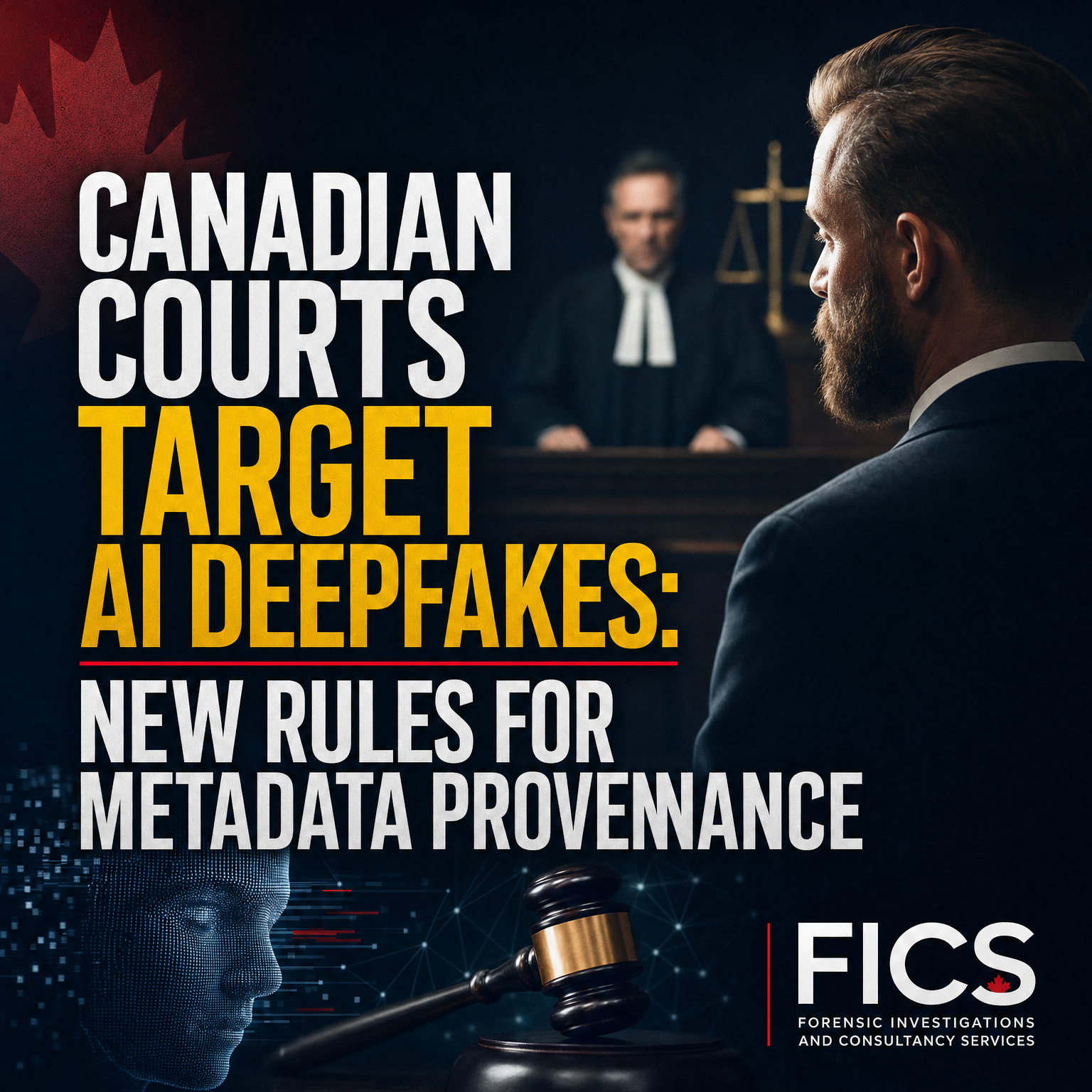
On November 3, 2026, Canadian Lawyer Magazine reported a pivotal development for Canadian jurisprudence: legal experts and the Canadian Judicial Council officially issued comprehensive guidance on AI deepfakes, metadata provenance, and digital evidence spoliation. This directive addresses the growing challenge of generative synthetic media in civil and criminal courtrooms across Canada.
For litigators, corporate counsel, and forensic professionals, this guidance shifts digital evidence handling from routine practice into a high-stakes compliance requirement. Courts will no longer accept unverified digital files at face value, nor will they tolerate procedural missteps that erase embedded technical data.
At Forensic Investigations and Consultancy Services (FICS), we frequently analyze digital evidence subjected to authenticity challenges. This milestone guidance establishes clear standards for what constitutes authentic digital proof and highlights the severe risks of metadata destruction.
The Judicial Guidance on AI Deepfakes and Metadata Provenance
The Canadian Judicial Council’s framework directly targets the dual threat facing modern courtrooms: authentic evidence falsely dismissed as synthetic—known as the "liar's dividend"—and sophisticated generative AI deepfakes presented as genuine records. To resolve these disputes, judges are instructed to evaluate the underlying technical lineage of any challenged digital asset.
+-------------------------------------------------------------------+
|                  DIGITAL EVIDENCE AUTHENTICATION                  |
+-------------------------------------------------------------------+
|  1. Metadata Provenance Analysis (EXIF, C2PA Manifests, Hashes)  |
|  2. Chain of Custody Audit (Bit-Stream Image & Forensic Logs)    |
|  3. Judicial Verification (Evaluating Spoliation & Authenticity) |
+-------------------------------------------------------------------+
Central to this evaluation is metadata provenance—the verifiable digital record detailing how a piece of media was created, edited, and transmitted. Courts now emphasize that native files containing full header data, Coalition for Content Provenance and Authenticity (C2PA) manifests, and raw file structures are essential for establishing admissibility.
Furthermore, judges are empowered to shift evidentiary burdens when credible deepfake allegations are raised. When an opposing party presents prima facie evidence of synthetic manipulation, the submitting party must provide verifiable forensic proof of authenticity. Failing to produce complete metadata records can result in immediate exclusion or adverse inferences under updated judicial guidelines for spotting unvetted GenAI in court.
Preventing Digital Evidence Spoliation Through Forensic Provenance
A critical aspect of the November 2026 judicial framework is its explicit focus on digital evidence spoliation. Spoliation occurs when relevant evidence is destroyed, altered, or inadequately preserved for litigation.
In digital forensics, spoliation often happens unintentionally during standard IT handling. Simply exporting a mobile video through a messaging app or converting a proprietary CCTV file to standard MP4 format strips critical EXIF headers, camera model signatures, and timestamp tracks. Under the new guidance, stripping this vital metadata during discovery may be ruled as spoliation of evidence.
[Original Recording] ---> [Standard Messaging Export] ---> [Stripped Metadata] = RISK OF SPOLIATION
[Original Recording] ---> [Forensic Bit-Stream Image] ---> [Preserved Provenance] = ADMISSIBLE EVIDENCE
Consider a commercial dispute involving a questionable audio recording. If the producing party provides a scrubbed audio file missing its original creation timestamps and device logs, the court may sanction that party for spoliation. Utilizing specialized forensic workflows—such as leveraging Nuix Neo AI audit trails for preserving forensic evidence—ensures every metadata layer remains intact from collection through trial presentation.
5 Actionable Strategies for Litigators and Forensic Teams
To ensure compliance with the Canadian Judicial Council's framework, legal and forensic teams should immediately incorporate five core operational practices:
- Collect Bit-Stream Images Immediately: Avoid drag-and-drop file transfers. Always perform full physical or logical forensic acquisitions that preserve native file containers, unallocated space, and creation metadata.
- Validate C2PA and Content Credentials: Check whether mobile devices or digital cameras embedded cryptographic content credentials at the moment of capture, and preserve these manifests intact.
- Establish Cryptographic Hash Baselines: Generate SHA-256 hash values immediately upon evidence acquisition to demonstrate that files have remained unaltered throughout the chain of custody.
- Audit Metadata Prior to Production: Work with certified forensic examiners to verify that production formats (such as PDF conversions or load files) do not strip underlying provenance headers.
- Prepare Expert Witness Documentation: Ensure forensic experts are prepared to explain provenance extraction methodologies in clear language that meets judicial standards.
Conclusion
The guidance issued on November 3, 2026, marks a definitive turning point for how digital evidence is handled in Canada. As generative AI models become increasingly capable of generating realistic audio, video, and documents, courts will rely heavily on technical metadata provenance to separate truth from manipulation.
Failing to maintain a verifiable forensic record risks not only evidence exclusion but severe judicial sanctions for digital evidence spoliation. Legal teams and corporate risk managers must modernize their digital evidence collection workflows to survive standard judicial scrutiny.
At FICS - Forensic Investigations and Consultancy Services, our certified forensic examiners specialize in extracting, verifying, and defending complex digital evidence. Contact our team today to conduct comprehensive forensic audits and safeguard your digital assets against generative AI challenges.